

Every price you have ever paid was a message.
The coffee that costs more than it did last year, the salary offer that came in lower than you hoped, the apartment you could not afford: each of those numbers was produced by a machine that runs quietly underneath the world, deciding what gets made, who makes it, and who gets to have it.
Economists call it the price system. Most people live their whole lives inside it without ever noticing it, the way a fish never notices water.
I am writing about that machine because it is about to process the largest shock in its history.
Nobody, and I mean nobody, knows what the future looks like with AI. That includes me, and I will flag my guesses as guesses throughout.
This essay is my attempt to look at that future through the economics’ own lens: demand and supply.
This lens turns out to be surprisingly powerful. The basics alone are enough to sketch two very different futures, both obeying the same rules, and which one we get depends on two variables that most conversations about AI never mention.
The machine in the background
I think the basic unit of this machine is price.
So what is a price?
A price is a message about scarcity. When something is scarce and wanted, its price rises, and that rising price does two things at once. It tells consumers to economize, and it tells producers to make more. When something becomes abundant, the price falls, and the signals reverse.
The price system is a continuous, decentralized negotiation between everyone who wants things and everyone who makes things, and it coordinates the actions of billions of strangers better than any committee ever could. Isn’t that interesting?
Demand is the wanting side of this negotiation: how much of something people will buy at each price.
Supply is the making side: how much producers will offer at each price.
Where the two meet, the market clears. Try to shift either curve and the price moves to a new equilibrium.
This is the first week of any economics course, and it is usually taught with wheat or coffee or crude oil.
There is another type of price - wages. We all know about wages. But let us dive a little deeper.
A wage is a price. It is the price of human labor, set by the same negotiation.
Employers demand labor. People supply it. The wage is where they meet.
When a skill is scarce and valuable, its wage rises. When a skill becomes abundant or replaceable, its wage falls.
But a wage plays a second role in the economy. It’s also a pipe. Someone has to pay for all the things we buy, right? For a big part of the economy, wages do that.
Wages are how purchasing power gets from the productive side of the economy into the hands of ordinary people. Most households buy things with money they earned by selling their labor.
Production creates income, income creates demand, and demand justifies more production. The circle closes. The machine hums.
This double identity of the wage, a price on one hand and a distribution mechanism on the other, is the single most important idea in this essay. Hold onto it.
The shock
Now introduce artificial intelligence. But let me look at it through the lens of economics rather than technology.
AI is a supply shock to labor. It is as if a new country appeared on the map overnight, populated by billions of tireless workers who never sleep, and work for the price of electricity.
Everything that follows rests on the assumption that AI eventually becomes a utility: abundant, competitively supplied, and priced near its marginal cost, the way electricity is. This is the essay's largest assumption, and it is not guaranteed.
There is a plausible world in which frontier AI stays expensive for decades, because compute stays scarce, because a handful of firms hold pricing power, or because the best models are rationed rather than sold. In that world, the machine's price stays high, humans remain competitive across a wide band of tasks, and much of the darker half of this essay recedes.
There is a widely held view among people who study AI's economics, from Sam Altman's argument that the cost of intelligence trends toward the cost of energy to the simple, observable fact that API prices have already fallen more than 90 percent in three years.
The history of computing is a history of collapsing marginal costs, and competition among model providers is already fierce. But this remains a judgment call, not a theorem, and if you who doubt it, you can reasonably discount everything that follows.
Granting the assumption, the basic model tells us exactly what happens next.
When the supply of labor explodes, the price of labor falls. Wages in any task that AI can perform get pulled down toward the cost of running the AI. At the same time, the goods and services produced by that labor become dramatically cheaper, because labor is a cost, and costs collapsed. Supply curves for nearly everything shift outward. Prices of products fall. Abundance, in the raw physical sense, increases.
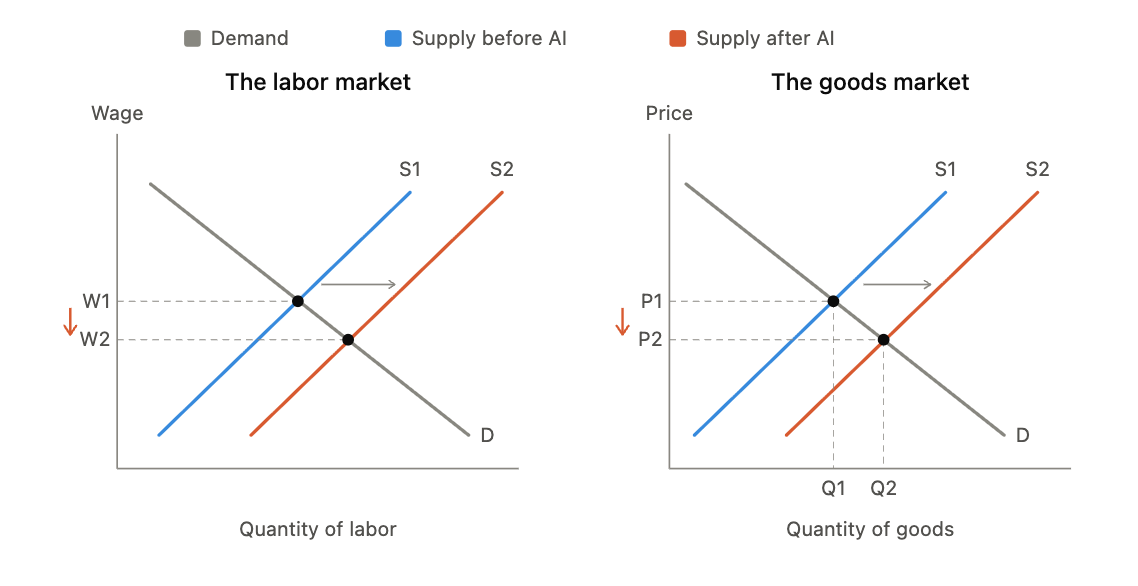
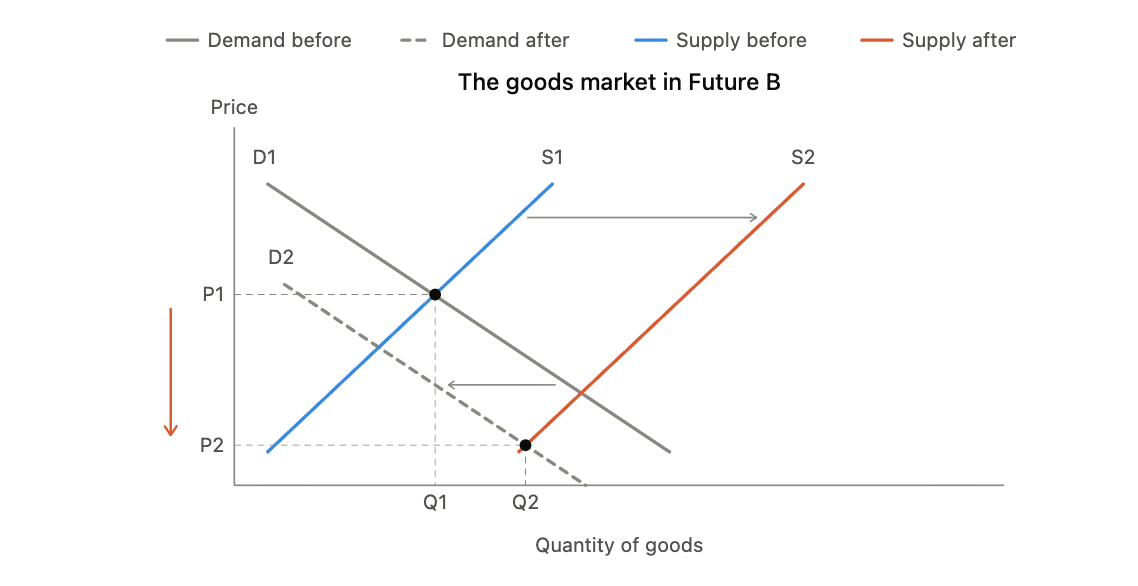
If wages fall or vanish across enough of the economy, the mechanism that delivers purchasing power to households starts to fail. And here the simple model produces a genuinely strange picture: the supply of goods surges outward while the demand for goods slides inward, because the people who would buy those goods no longer have labor income to spend. Robots do not buy cars. Language models do not take vacations.
You can, in principle, have the most productive economy in human history and a demand collapse at the same time. Markets would still clear, as markets always do, but they can clear at an equilibrium of astonishing capacity and widespread exclusion.
Whether that happens depends on two things.
First, where does demand migrate when the old goods become cheap?
Second, if wages stop distributing income, does anything replace the pipe?
Answer those two questions optimistically and you get one future. Answer them pessimistically and you get another.
Future A: the great migration
Meera is a radiologist in 2035, in the first future. The diagnostic part of her job disappeared years ago. An AI reads scans faster and more accurately than she ever did, and she would be the first to admit it. What she does now did not exist when she trained. She runs a clinic built around the hours the machines gave back: long consultations, judgment calls on ambiguous cases, the work of sitting with a frightened patient and being a human being with medical authority. This is the case of AI 'augmenting' her work rather than completely 'automating' it. Her income took a hit during the transition, because migrations are usually a period of chaos, and then recovered. It turned out that when diagnosis became nearly free, people wanted far more medicine, and the scarce thing shifted from reading the scan to everything around it.
This is the migration story, and it has history firmly on its side. Every previous automation wave triggered the fear that there is a fixed amount of work in the world, so that work done by machines is work subtracted from humans. Economists call it the lump of labor fallacy, and it has been wrong every single time. Agriculture went from employing the vast majority of workers to a small fraction of them, and within a few generations the descendants of those displaced workers held job titles that would have been gibberish to the farmers they descended from.
The mechanism behind the pattern is pure supply and demand.
When automation collapses the price of existing goods, freed-up purchasing power goes hunting for whatever remains scarce. Demand migrates toward things machines cannot make, or things that lose their meaning when machines make them like care, craftsmanship, live performance, experience. New industries condense around these new scarcities the way new towns condense around new railways, and labor follows the demand.
In Future A, this pattern holds one more time. The transition is genuinely brutal for the people caught in it, as migrations always are. But the destination is an economy where goods are nearly free, where human work has moved to the frontier of new wants, and where the wage pipe, though it carries different water, still flows.
Supply and demand did what it always does: it relocated.
Who pays?
Before accepting Future A, you would probably be holding one question. The migration story says displaced workers will find new jobs serving humanity's new wants: the craftsmanship, the care, the experiences.
In economics, though, demand means desire backed by the ability to pay, and the ability to pay has to come from somewhere. A billion people wishing for handcrafted furniture adds up to a mood. It becomes a market only when money stands behind the wishing.
Look closely at how previous migrations closed this loop. The farm worker who moved to the factory received a factory wage, and that wage became the money he spent at the barber, the tailor, and the cinema. That spending is precisely what created the service jobs the next wave of displaced workers moved into.
Each new industry did two things at once: it absorbed labor, and it issued the paychecks that funded the demand for the industry after it. The migration of work and the distribution of income were the same event.
AI threatens to split those two things apart for the first time. When the AI does the work, the value survives: the goods are still made and the revenue is still earned. But more of it now accrues to whoever owns the inputs that stay scarce, like the compute, the energy, the data, and the capital behind the machines, bypassing many of the paychecks it once traveled through.
And then Future A develops a circularity problem. The human-premium economy needs customers, but its intended customers are the displaced workers themselves. The caregiver, the artist and the craftsman are all ready to serve one another but none of them has the income to be served. Everyone is selling and no one can buy.
There is the counterpoint. The wage is only one of the economy’s pipes. Households also receive government transfers and capital income: dividends, pensions, and retirement funds that own shares in the very companies deploying the AI. In the rosiest version of Future A, collapsing prices, broadening share ownership, and modest transfers together keep enough purchasing power circulating to sustain the new human economy.
But notice what that argument concedes. For most households today, capital income is a rounding error beside the paycheck. The moment Future A leans on dividends and transfers to keep its customers solvent, it has quietly admitted that the wage pipe alone will no longer do the job. That admission means even the optimistic future depends on the same plumbing that the pessimistic one makes explicit.
The two futures, it turns out, agree that the pipe must be rebuilt. They disagree only about how much of it, and how soon.
Future B is what the world looks like when the rebuilding never comes, or comes too late. Keep the question of who pays in your mind as you read it, because the second future is the one where nobody answers it.
Future B: the great decoupling
So run the tape again, this time with one assumption changed.
Meera, in the second future, closed the clinic years ago, because the consultation is also gone. The technology is the same as in the first future. The difference is that here, people stopped insisting on a human for it. The AI reads the scans, explains the results, comforts the frightened, and weighs the ambiguous cases, all at once and at almost no cost. Every time she retrained toward the remaining human frontier, the frontier moved.
Why should this time be different? Look closely at how the old transitions actually worked. When the car replaced the horse carriage, the carriage driver became a car driver, and the move worked for a reason nobody thinks about: the car arrived incomplete. It had no mind. It needed a human in the seat to see the road, judge the moment, and steer. Every previous machine shipped with an empty seat like that. Tractors needed operators, computers needed programmers. The new work was always the work of being the machine's missing piece, and the missing piece was always a mind.
AI is the first machine in history that arrives with its own driver. The missing piece is no longer missing. This machine is the mind, and there is no empty seat left to slide into. We tried to build one anyway. Prompt engineering, one of the very job titles Future A celebrated, was invented as the craft of steering the new machine with well-chosen words. The craft still exists, and it keeps shrinking, because steering a language model is itself a language task, and every improvement in the machine is an improvement in its ability to steer itself. The seat exists for exactly as long as the machine stays immature.
Economics does hold one more line of defense. The idea is called comparative advantage, and the classic illustration is a lawyer who happens to be the fastest typist in town. She is better than her assistant at both law and typing, yet it still pays her to hire the assistant, because every hour she spends typing is an hour she cannot bill for legal work. The assistant gets a job despite being worse at everything, because what matters is not who is better but what each party gives up.
The same logic should rescue us from AI. Compute is finite at any given moment, so it makes sense to point the machines at their highest-value work and leave the rest to humans. Humans keep working, even in a world where the machines are better at everything.
It is a theorem, but it has one breaking point. It assumes the weaker party can survive on what the trade pays. Nobody will pay a human more for a job than the machine charges for the same job, so the machine’s price becomes a ceiling on every human wage. And if that ceiling drops below what a person needs to live on, the theorem still holds perfectly on paper. The human just starves in practice.
Notice that this breaking point depends on an earlier assumption: it only bites if the machine’s price actually falls that far. If AI stays expensive, the ceiling stays high, and comparative advantage keeps doing its old, benign work. The theorem and the price assumption stand or fall together.
A fair question at this point is whether all of this assumes that physical work gets automated too: the plumbing, the construction. In its complete form, yes, and robotics runs years behind cognition. But the fork does not wait for robots.
When cognitive work disappears, the displaced do the rational thing and move toward the work that remains, and that flood of new workers pulls manual wages down without a single robot being built. It is the essay's first lesson replaying itself in the trades: when the supply of labor explodes, its price falls. Everything is driven by demand and supply.
Other kinds of work will hold out too. Some jobs survive because the law requires a human to be accountable: the surgeon who signs the consent form, the auditor who certifies the accounts, the judge who passes sentence. Some survive because the humanness is the product: the therapist, the live performer, the athlete. Nobody watches machines play chess, even though they have been superhuman for decades, because the human struggle is the thing being sold. And some work survives at the very top of the chain, because machines execute goals and someone must still choose the goals, own the capital, and bear the risk.
Every one of these holdouts is real. None is large enough to carry the pipe. Accountability roles are few by design, human-premium goods are luxuries by definition, and choosing goals is work for a small number of people, too few to absorb a workforce.
Here you might spot an apparent escape hatch. If prices are crashing toward zero, does a crashing income even matter? Purchasing power is income divided by prices, and in Future B both are falling. If a year of food, software, entertainment, and medical diagnosis costs almost nothing, then almost nothing is enough to buy it, and the dystopia dissolves into a cheap and comfortable retirement for the species.
The escape hatch is real, but it has a catch, and the catch is where Future B gets its teeth. AI collapses the price of cognition and of anything cognition can cheaply reproduce. It does not collapse the price of things that are scarce for physical or legal reasons: land, housing in the cities people want to live in, energy, water, the minerals under the ground, the right to occupy a particular place on the earth. Those prices do not fall when intelligence gets cheap.
If anything they rise, as those who captured the surplus bid against one another for exactly these assets. You can live like a king in the parts of the economy AI touched and be locked out of the parts it did not, and the parts it did not touch include the roof over your head.
So in Future B, the pipe fails. Production has never been greater, and it flows almost entirely to whoever owns the inputs that stay scarce. Wage income evaporates across most of the economy, and with it goes broad-based demand for everything except the necessities whose prices never fell.
This is the strange picture the basic model warned us about, now with sharper edges: warehouses full of nearly free abundance, a population without the purchasing power to claim the scarce goods that matter most, and supply and demand performing flawlessly throughout.
The casualty was the assumption we built a civilization on, that selling your labor is how you get your share.
The exit from Future B, if there is one, runs through plumbing.
If wages no longer distribute income, something else has to, though what that something is remains genuinely open.
One candidate reframes the whole question. The models were trained on the accumulated output of human work: everything ever written, coded, drawn, and recorded. In that sense the machine is a store of past labor. A dividend paid out of its revenue, then, is not a handout. It is a royalty, payment for an input humanity already supplied. I don't know if that framing survives contact with reality. But it changes the question from charity to ownership, and that is a different question.
Other designs might work too, and it’s probably a mistake to treat any of them as settled.
Ownership could be broadened, the way Alaska pays every resident a dividend from its oil. Income could be paid directly from the machine’s output.
Or the problem could be inverted altogether: rather than raising the income people have, lower the cost of what they need, since the essentials AI touches may be exactly the ones whose price falls toward zero.
Each of these is usually argued about as ideology. Seen another way, they are just candidate replacements for a broken pipe, and the list is almost certainly incomplete.
The old pipe took centuries of trial and error to build. The new one probably will too, which means the design that matters most may be one nobody has written down yet.
And there is a complication I can’t resolve. Every pipe on that list is national plumbing for what may be a global leak. The capital that captures the value seems to concentrate in a few places, while the wage erosion looks worldwide. A country that exports cognitive labor at scale could find itself on the receiving end of the shock without owning much of the capital on the other side. The royalty idea gets harder here rather than easier: the training data came from everywhere, from every language and legal code humanity has produced, yet any dividend built on it would likely be paid within borders the data never respected. Whether that tension ever gets resolved, and how, I honestly don’t know. I’ll just mark it: the pipe problem may also be a geography problem, and the geography version looks harder.
What does seem clear is the underlying pressure. In Future B, keeping income flowing may stop being a matter of preference and become something closer to a requirement, because an economy of producers with no consumers is not obviously an economy at all.
The real fork
So which future do we get? The choice between the two is partly an illusion, because Future B cannot hold. Two forces inside it pull it apart.
The first is commercial. Whoever captures the surplus still earns it from millions of customers, and an economy that destroys its consumers destroys its producers a quarter later. Capital has rebuilt the demand pipe before, out of self-interest rather than charity.
The second is political. A majority with no income and a full vote does not quietly accept being locked out of visible abundance. Democracies reprice. Through taxes, through ownership funds, or through something rougher, purchasing power finds its way back, because the alternative is that the arrangement holding everything in place stops holding.
Follow that logic to its end and the two futures collapse into a single destination reached by two roads.
On the first, the plumbing arrives early and by design: the transition still hurts, as every migration does, but the new pipe is laid while the old one still carries water.
On the second, it arrives late and in panic, after years of collapsed demand, vanished savings, and political fury make the repair unavoidable.
Both roads end at a rebuilt pipe. Nearly all of the avoidable suffering sits on the second one.
So the real fork is not which future, but how fast: how quickly wages erode, against how quickly institutions respond.
I opened by saying nobody knows what the future looks like with AI. I stand by that. But not knowing the future is not the same as knowing nothing. Supply and demand will keep doing what they have always done, and the machine will deliver the abundance either way. What it cannot decide is who gets to claim it. That comes down to the pipe: the thing that carries income from the economy into ordinary hands.
For all of history that pipe has been the wage. AI is cracking it. The only question left is how fast we build the next one.
For this essay, I found myself reading economics again, a year after my MBA. And I was reminded of why the subject interested me in the first place. Beneath all the equations sits one elegant idea: things become scarce, people want them, prices whisper, and the world rearranges itself. Demand and Supply!
References
The Use of Knowledge in Society