
the art of subtraction
The strategy behind Apple’s 1997 turnaround

It was October 6, 1997, at a Gartner conference when a member of the audience asked Michael Dell, then CEO of Dell Computers and one of the most powerful figures in the PC industry, what he would do if he were running Apple.
“I’d shut it down and give the money back to the shareholders.”
Apple had just lost $1.045 billion in a single fiscal year. It was manufacturing 350 products nobody could tell apart. It was 90 days from total bankruptcy.
Logic said Dell was right. Fortunately for all of us, he wasn't. Otherwise we wouldn't have seen the iPhone or the iPad.
Let me tell you a story today. A story of how Apple was reborn.
Some moments in a company’s life are not just decisions. They are forks in the road. Take the wrong one, and you disappear. Take the right one, and you rewrite history. Apple was standing at that fork in 1997.
The Crisis
Apple in 1996 was a company in freefall.
It had spent a decade trying to be everything to everyone. Dozens of Mac models with names like Performa, Centris, Quadra, and LC that even Apple’s own employees could not explain. Printers, digital cameras, a handheld called the Newton. Apple’s best engineers were working on products nobody asked for.
The board had fired Steve Jobs in 1985. In the eleven years that followed, Apple burned through three CEOs. John Sculley, the Pepsi executive Jobs himself had recruited, grew the company but lost its soul. Michael Spindler tried to sell Apple to IBM and failed. Gil Amelio took over in 1996 and lasted 500 days.
Meanwhile, Microsoft and Intel had built a fortress. Intel supplied the chips. Microsoft supplied the software. Every PC maker on earth, Dell, HP, Compaq, fell in line, assembling boxes on razor‑thin margins while Microsoft and Intel collected the toll on every unit sold. This in itself is a great story about how two companies built a shared platform that captured almost the entire PC industry. I’ve added it to my list of topics to write about someday.
Apple’s market share had collapsed from 16% in 1980 to under 4% by 1997. It was the only major holdout, running proprietary architecture, its own OS, its own hardware. That made it expensive, incompatible, and easy to dismiss, according to most analysts of the time.
Even Apple’s own open licensing experiment was backfiring. The Macintosh clone program had been meant to broaden the ecosystem, but by 1997 it was cannibalizing Apple’s highest margin hardware sales without creating enough licensing revenue to justify the loss.
Warehouses were full of hardware losing value by the hour. Inventory sat at 60 days. Morale had collapsed. Engineers were leaving. The eulogies were already being written.
Something had to be done.
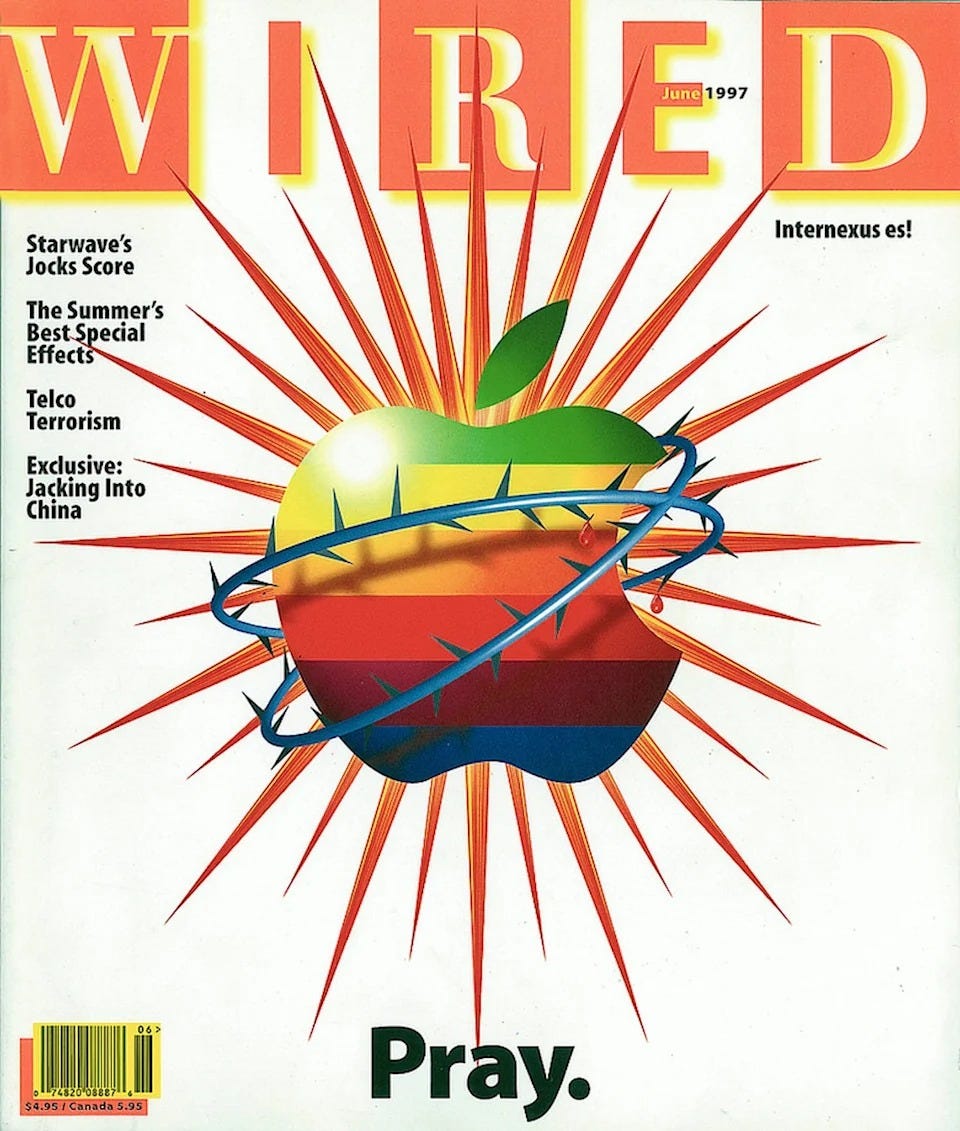
The Return of Jobs
In December 1996, Apple announced it was acquiring a company called NeXT for $429 million. Officially, it was a technology deal. Apple needed a modern operating system, and NeXT had one. That was the story the press was told.
What nobody fully understood at the time was that Apple had not just bought a software company. It had bought back its founder as a consultant.
Jobs quickly identified that Apple was executing very well on the wrong things. His diagnosis was that the company’s plan was fundamentally flawed because it sought to be everything to everyone, thereby becoming nothing to anyone.
Jobs’ transition to interim CEO in September 1997, following Gil Amelio’s forced resignation, marked the moment that diagnosis turned into a series of brutal, deliberate cuts.
Less is More
At the 1997 Worldwide Developers Conference, Jobs put the idea in plain language.
“People think focus means saying yes to the thing you’ve got to focus on. But that’s not what it means at all. It means saying no to the hundred other good ideas that there are. You have to pick carefully. I’m actually as proud of the things we haven’t done as the things I have done. Innovation is saying no to 1,000 things.”
- Steve Jobs
This philosophy challenged the conventional wisdom of market expansion and replaced it with a mandate for strategic parsimony.
The first order of business was to purge the product portfolio of anything that did not meet a standard of absolute excellence or strategic necessity. Jobs started with the Newton. It had a loyal following in niche markets like medicine and logistics, but to him it was underperforming and fundamentally flawed, built around a stylus‑based interface that simply did not work. He killed it.
At the same time, he shut down the Macintosh clone program. The clones had been meant to grow the Mac ecosystem, but in reality they were cannibalizing Apple’s own high‑margin hardware sales while generating little licensing revenue in return.
The data behind the cuts is brutal:
Core computer categories: from 15+ to 4
Inventory days: from 60 to 6
Roughly 70% of all products were killed
The Four-Quadrant Execution
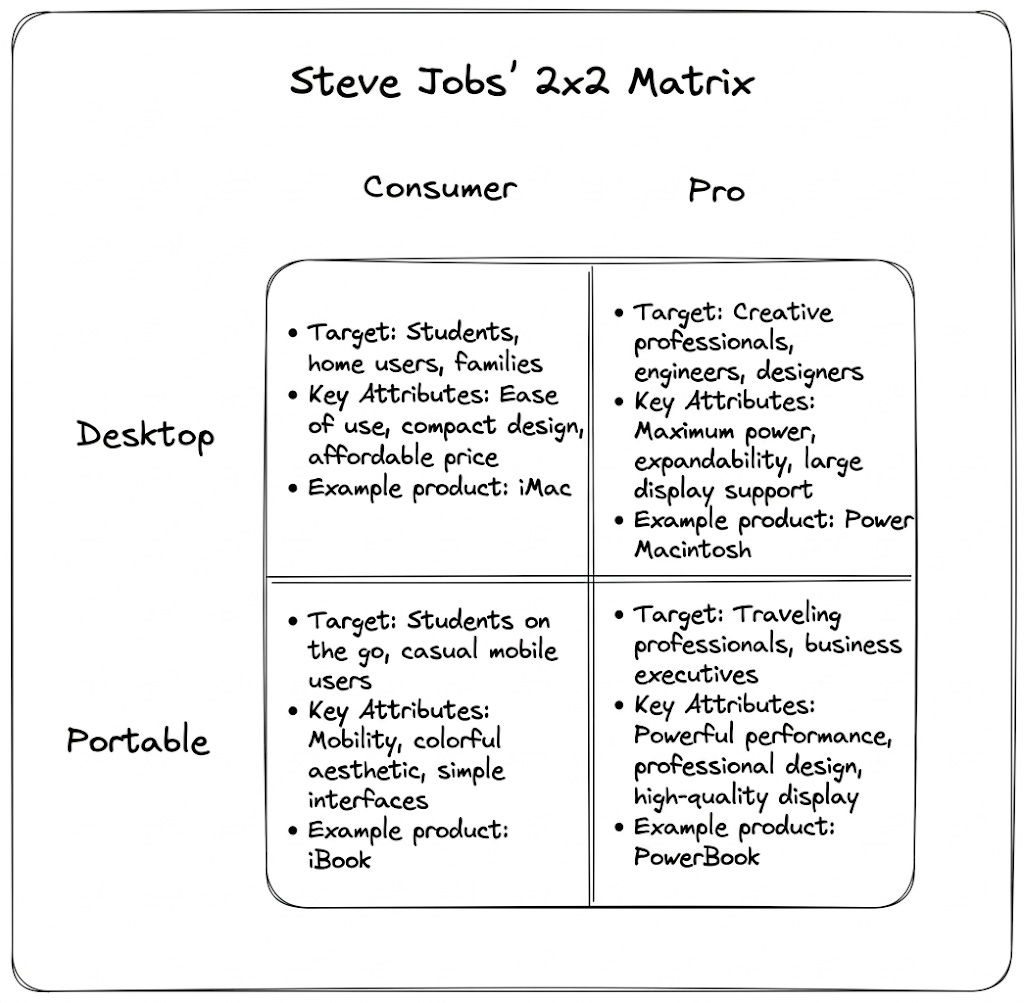
I love the 2×2 matrix. It is simple, and it works (most of the time). To replace the chaotic spread of 350 products, Jobs brought in a clean idea: the 2×2 product matrix. In a strategy meeting, he went to a whiteboard and drew a simple grid. The rows were “Desktop” and “Portable.” The columns were “Consumer” and “Professional.” This grid defined exactly four categories that Apple would build. Any product that did not fit into one of these four quadrants was shut down immediately.
The Organizational Shift
To shift from a struggling, chaotic company to a focused powerhouse, Jobs did not just prune the product line. He tore down the entire organizational structure. He dismantled the old multidivisional model. In its place, he instituted a functional structure where the entire company operated under a single, unified P&L.
Senior Vice Presidents were responsible for functions, such as design, hardware engineering, software engineering, marketing, and operations, rather than for specific products. By centralizing the P&L at the CEO level, Apple removed the incentive for product teams to compete for resources or argue over internal transfer pricing. This functional discipline kept the company agile, allowing it to scale massively without losing its soul. While most companies move toward divisional, product-based structures as they scale to prevent bottlenecks at the top, Apple has doubled down on the functional model.
The Operations Shift
While Jobs redefined the product and corporate strategy, he recruited Tim Cook in 1998 to overhaul the company’s disastrous operations.
The reduction of the product line was the catalyst for an operational transformation that became Apple’s hidden moat. Cook consolidated suppliers from over 100 down to 24 and embraced a “just-in-time” model. This drove inventory turnover from 60 days down to just 6 days within nine months, and eventually to 2 days within a year. This efficiency freed up massive amounts of working capital, which was reinvested into the design and R&D that had been starved under the previous regime.
This operational discipline also supercharged development. By streamlining the entire manufacturing process from four months down to two, Apple could move faster than any competitor in the industry. While rivals remained bogged down managing their own bloated, inefficient portfolios, Apple was already shipping the next great product.
Branding and Survival: The Renaissance of Identity
The 1997 turnaround was a race against time. The strategy was not just about cutting, but about defining what Apple stood for. Jobs believed that marketing is about values, and he moved quickly to rebuild the brand. To buy time for his product and operational reforms, he took a bold and pragmatic step in August 1997. He negotiated a $150 million investment from Microsoft. This lifeline pulled Apple back from the brink of bankruptcy, giving him the breathing room to execute his long-term vision.
Just one month later, he launched the Think Different campaign. It did not feature computers. Instead, it featured icons of creativity and rebellion, such as Einstein, Gandhi, and Dylan. This campaign had two strategic purposes:
Market Positioning: It re-established Apple as a brand for the creative class, distancing it from the boring and utilitarian beige of the PC industry.
Internal Rallying Cry: It signaled to employees that the era of bloated and unattractive products was over, replacing despair with a clear sense of mission.
The physical manifestation of this new identity arrived with the 1998 iMac G3. With its translucent, Bondi Blue casing, it was bold, simple, and unapologetically distinct. By selling 278,000 units in its first six weeks, the iMac proved that the “NO” strategy, creating space for one great product, could capture the public imagination in a way that 350 mediocre products never could.
All of this led to a total financial swing of $1.35 billion, shifting Apple from a $1.045 billion loss in fiscal year 1997 to a $309 million profit in fiscal year 1998. During this same period, Mac unit sales actually dipped slightly from 2,874,000 to 2,763,000, representing a 4 percent decline.
The financial data reveals a critical insight into the “NO” strategy. The return to profitability was not driven by a massive increase in unit sales. It was driven by a radical improvement in margins and the elimination of wasteful spending and unprofitable product lines. Apple proved that it was more profitable to sell fewer things of higher quality than to sell many things at a loss.
Nine years after that Gartner conference, Apple’s market cap finally surpassed Dell’s. Jobs celebrated by sending an email to his entire team:
“Team, it turned out that Michael Dell wasn’t perfect at predicting the future.”


The Key Takeaway
Two forces drove Apple’s revival: resilience and the absolute mastery of the Art of Subtraction.
Steve Jobs came back, first defined what Apple stood for, then ensured every process (product, organization, marketing, operations) revolved around that manifesto. It was brutal. But it was exactly what Apple needed.
The takeaway is simple, but expensive:
Excellence is an act of curation, not accumulation. Before you begin, define exactly what you stand for. Then, ruthlessly examine every project, commitment, and habit through that lens. Be it professional or personal. If it fails to align with your manifesto, cut it. Ignore your sunk costs. Disregard the superficial appeal of a “good” idea that no longer serves your core objective. Divestiture is not always bad. It is often essential.
It requires the courage to kill good ideas so that great ones have the space to thrive.
References
All the things Wired got hilariously wrong in its legendary 1997 story on how to ‘save’ Apple
The Understudy Takes the Stage at Apple
Apple Enters The Ternus Era As Investors Weigh Its Next Innovation Cycle
Steve Jobs Saved Apple by Overcoming Divestiture Aversion. It Will Work for You, Too